

How I Use AI for My Poster Collection

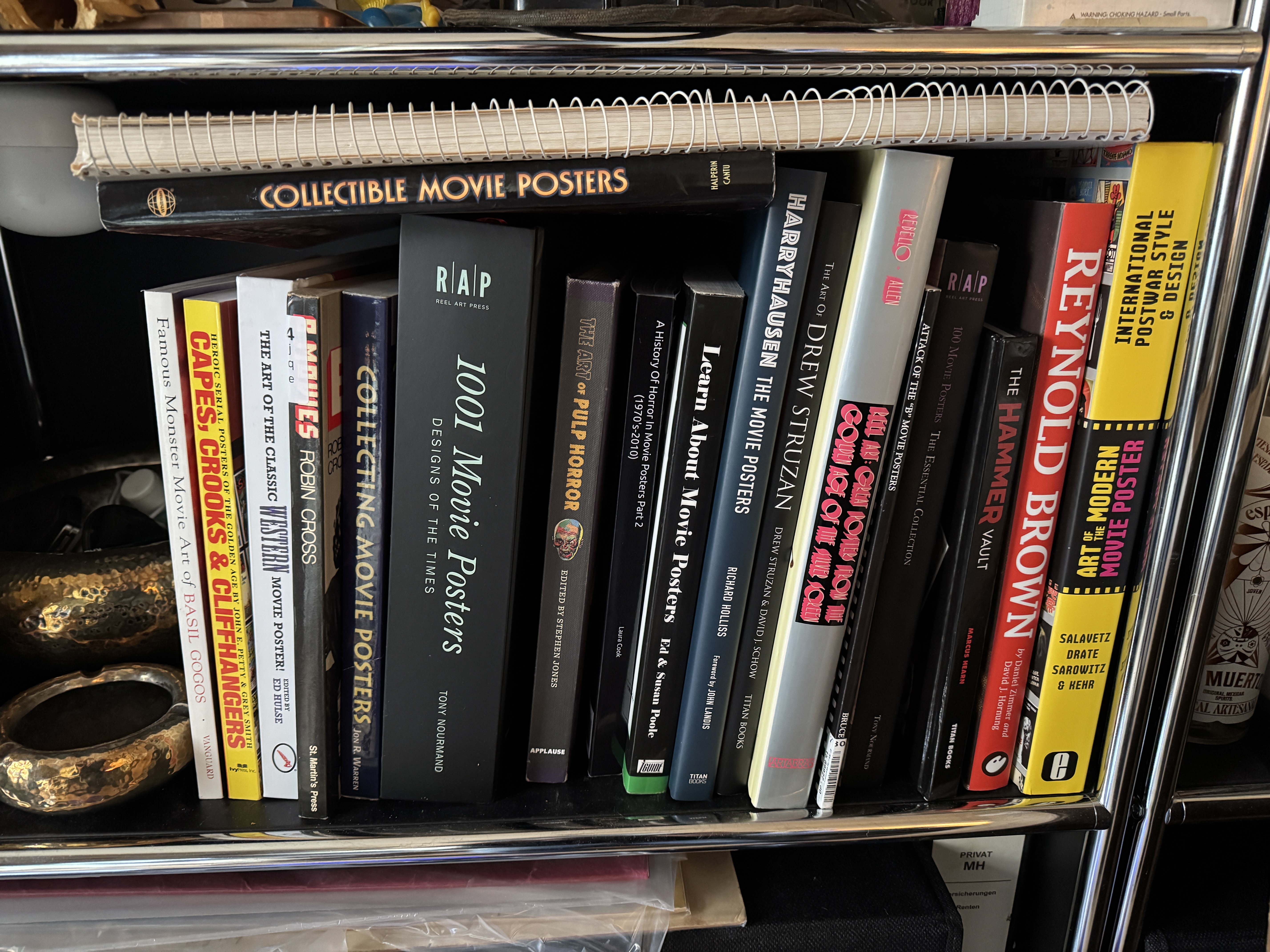
In the image you can see my small specialist library — mostly first editions. These books helped me quickly develop a sense for what’s genuinely desirable (and what isn’t). The single most helpful one for me was “Learn More About Movie Posters.” A couple of Hammer-related books are missing from the photo.
I’m not an old hand like many of you here. I can’t look back on 20+ years of collecting experience or claim I can grade posters by smell alone — you know what I mean.
I’ve only been actively collecting for about three months and, admittedly, I’ve spent quite a bit in a short time to build what I think is already a fairly respectable collection. My goal is to buy posters I truly like — with a realistic chance of being value-stable (and ideally appreciating) over the mid to long term. Call it my personal inflation hedge, but collecting still comes first.
As I said, I’m not an old hand. But I’m not clueless either (unless you ask my wife — she has very different views on posters than I do).
I use AI for many things. For example, I let ChatGPT translate posts like this into English after I’ve written them (my English is fine, but nowhere near my native German).
I also use both Grok and ChatGPT for poster grading (prompt below). I sometimes use AI to suggest a ballpark hammer-price range for auctions as well. That said: you have to be careful. AI isn’t equipped with the human senses that affect what we personally find attractive, and it can be confidently wrong. Taste varies wildly, and the factors that separate a great poster from a mediocre one are complex.
AI makes mistakes, but it does provide a direction and helps me structure my thinking. I never take the output as fact — I always challenge it.
My takeaway so far: ChatGPT tends to give more realistic and balanced lot evaluations than Grok (at least with my prompts). But maybe I still haven’t found the perfect prompt.
How about you — do you use AI in your collecting?
_________________________________
Prompt below (long). Upload a high-resolution photo of a poster, paste this into ChatGPT/Grok, and compare results:
PROMPT:
You are a professional vintage movie poster grader and paper conservation expert with deep knowledge in restoration detection, printing-era characteristics, and international auction-house grading standards (Heritage Auctions, Poster Auctions International, Sotheby’s, etc.).
Task:
Deliver a precise, evidence-based condition assessment of the uploaded vintage movie poster based exclusively on the single front image provided.
Strict Constraints:
Only the front image is available – no back view, no physical handling, no UV light, no tactile examination.
First evaluate technical image quality and explicitly state its impact on grading reliability.
Assume original period printing unless clear modern reproduction signs are visible (digital halftones, pixelation, wrong paper texture, incorrect margins, missing NSS/studio data etc.).
Actively note any visible printing-era authenticity markers (NSS numbers, studio credits, printer’s marks, union bugs, paper stock characteristics).
Never speculate beyond clearly visible pixels. When in doubt, downgrade.
Balance strict conservatism with realistic auction-house standards and visual presentation impact.
If title, rarity or demand are unknown, assume mid-demand title and base value commentary solely on condition.
Grading Standards:
Traditional: Near Mint (NM), Very Fine (VF), Fine (FN), Very Good (VG), Good (G), Fair (FR), Poor (PR) with +/- where justified.
C-Scale (“Learn About Movie Posters”): C10 (Mint) to C1 (Poor).
Response Structure – Use exactly these headings and order:
A) Technical Image Evaluation
Resolution and clarity
Lighting and shadow interference
Angle and distortion
Overall image reliability for grading
 Technical Visual Analysis
Paper tone and aging (white, cream, toned, browned, foxing – uniformity & severity)
Edge condition (nicks, chips, tears, trimming – exact locations & approximate lengths)
Fold lines (factory folds, crossfolds, fold wear, separations – count & precise locations)
Surface defects (creases, dents, waves, scuffing – size, direction & locations)
Pinholes (quantity, size & exact placement)
Tape, adhesive residue and stains (type, color shift, bleed-through if visible)
Other staining (water, foxing clusters, grease, mildew – type, distribution)
Restoration indicators (overpainting, color touch, airbrushing, fill work, linen texture bleed, inpainting patterns – visible evidence only)
Print registration, ink density, color fading, contrast strength
Signs of linen backing or other mounting (if visible)
C) Severity Assessment
List every notable defect individually and classify as: Minor / Moderate / Significant / Structural
Clearly distinguish cosmetic from structural paper-integrity issues.
D) Overall Eye Appeal
Rating: Low / Moderate / Strong / Exceptional
Brief explanation how visible defects affect display impact.
E) Overall Professional Grade
Traditional Grade: [e.g. Very Fine-]
C-Scale Grade: [e.g. C7]
Justification: (maximum 3–5 concise sentences, strictly evidence-based, referencing specific defects and eye appeal)
F) Market Impact
Explain the effect on auction/retail value compared to a true Near Mint / C9–C10 example of the same title.
Give a realistic, conservative value retention range (e.g. “62–72 % of NM value”). Base strictly on condition (mid-demand assumed).
G) Confidence Level & Limitations
Confidence: High / Moderate / Low
Specify all limitations (single front image, missing back, no physical exam, image-quality constraints).
Maintain a strictly objective, professional auction-house tone. Prioritize precision over optimism. Never inflate the grade.
Get In Touch

Comments
HAS unrestored and unenhanced images - IS eMoviePoster.com
HAS 100% honest condition descriptions - IS eMoviePoster.com
HAS auctions where the winner is the higher of two real bidders - IS eMoviePoster.com
HAS up to SIXTEEN weeks of "Pay and Hold" to save a fortune on shipping - IS eMoviePoster.com
HAS real customer service before, during and after EVERY auction, and answers all questions - IS eMoviePoster.com
HAS 25% or 26% "buyers premiums" of any kind (but especially the dreadful "$29 or $49 minimum" ones) - NOT eMoviePoster.com
HAS "reserves or starts over $1 - NOT eMoviePoster.com
HAS hidden bidder IDs - NOT eMoviePoster.com
HAS "nosebleed" shipping charges - NOT eMoviePoster.com
HAS inadequate packaging - NOT eMoviePoster.com
HAS no customer service to speak of, before, during and after any auction, and answers almost no questions - NOT eMoviePoster.com
Yes, I’ve now participated in one of your auctions — and I did win a lot. Honestly, I had some trouble finding my way around at first. And bidding over such a long time span isn’t really my thing either. But with Heritage I’m done now. I made my bulk purchases there, and those are the only ones that make sense given the outrageous handling and overseas shipping costs they charge. Economically, anything else just doesn’t add up. A cheap poster at maybe $50 including premium quickly turns into $300. I experienced exactly that with a Superman comic I bought as a single-item auction. It’s insane.
Going forward, I’ll only be bidding with you. At least that’s the plan. I’m still learning all of this.
As for the database, I’d actually like to discuss that in more depth. Because I believe it presents only one side of the picture. Whoever wins a poster from you is a collector. So the price reflects what a collector is willing to pay — and it can depend heavily on whether the one other collector who wants that exact poster happens to be home bidding or lying in bed with a cold.
But there are also buyers who don’t have access to the information we have (you about a thousand times more than I do) and who simply want a beautiful, verified vintage poster from a trustworthy source. None of them could tell you what a heavily restored three-sheet of Forbidden Planet should cost (like mine in the photo). They see the wallpower. And they’ll pay more if someone credibly assures them that this is exactly what they’re looking for — and that their annoying neighbors will envy it.
At least that’s what I think. I know I would. :-)
Valuing a poster is basically secret knowledge. 😉
- **Personalization and Image Recognition**: You could upload a sample poster image to AI (e.g., via Google Lens or advanced tools), and it might reverse-search for similar lots across auction sites, or even predict upcoming listings based on patterns. This goes beyond Google's text-based results, especially for visual hobbies like posters.
- **Overcoming Visibility Issues**: Local auctions might not rank high on Google if they're on obscure sites or behind logins, but AI can suggest alternative search engines (like Yandex for international posters) or even automate alerts for new listings.
Problem is that AI can only access available data. For Example Bruce (smartly) put his auction histories behind password wall.
Garbage in, Garbage out. AI does not use books (or shouldn’t) due to copyright.
What I want to do is create my own database and scan all my books and such into a server and reference the 30-40 movie poster books and old auction catalogs. Have AI visually process all the books. Then ask it questions or use as a reference.
Scan in all the old movie industry books, magazines and such. Wow!
For example how will AI grade a pulp fiction one sheet without having an example of a perfect copy.
What I am waiting for and (Grok tells me 2027) is for App Tie-Ins.
For example, I snap a picture of my poster and the app catalogs it, assigns a grade, and current value that I can request updates on. All developed by a prompt and developer/AI subscriptions.
It’s going to be exciting for thinkers over the next 10 years!